
Searching for foundation repair cost in La Jolla usually means you have seen cracks, sloping floors, sticking doors, or a report that raised concern—and you want a realistic budget picture before calling anyone. Honest answer up front: anyone offering a firm dollar total for your house before seeing the site and defining scope is guessing. There is no verified community-wide “typical La Jolla repair price,” no reliable ZIP 92037 average band, and no responsible online calculator that can replace diagnosis.
What this page can do is teach the cost stack—the factors that move project economics in La Jolla—and show real City of San Diego municipal fee line items from official Development Services schedules. Those dollars are plan-check, inspection, and discretionary processing charges. They are not contractor repair quotes and they are not “what you’ll pay total.”
La Jolla Structural connects property owners with appropriate licensed specialists serving the area. We do not bid jobs, warrant work, invent price menus, or impersonate a contractor or engineering firm.
Request a Foundation Evaluation
Why “average cost” pages mislead La Jolla homeowners
National contractor blogs often publish “average foundation repair cost” tables. Treat those figures as uncertain market context at best—not La Jolla-specific authority and not a substitute for a written bid on stamped scope. Two homes on the same street can face entirely different economics because of different distress mechanisms, foundation systems and access, parcel overlays (Coastal Overlay, Environmentally Sensitive Lands steep-hillside rules, geologic hazard categories, 45+ year historic review), and whether geotechnical investigation plus stamped structural plans are required before a meaningful construction bid exists.
Comparing a marketing “average” without matching mechanism, access, and permit path is how homeowners buy the wrong scope—or reject a fair bid that includes engineering they actually need.
What homeowners actually pay for (the cost stack)
A complete foundation project in the City of San Diego often includes more than the construction invoice:
- Investigation / diagnosis — symptoms, mapped-hazard screening, and deciding whether engineering or geotech is needed
- Geotechnical investigation — when City rules or conditions trigger it (amounts are project-specific; this site will not invent “typical PE fees”)
- Structural (civil) design / stamped plans — when required for permit and construction
- City / agency fees — plan check, inspection, administrative fees, discretionary deposits, grading, historic review hours
- Construction by California Contractors State License Board (CSLB) licensees whose classifications match the method
- Related work — drainage or subdrains, access staging, temporary shoring, utility protection, and restoration of finishes or landscape
Items 1–4 and 6 are frequently underestimated when homeowners shop only against contractor marketing averages. Start with foundation inspection thinking, then move to foundation repair process—not the other way around.
Cost factor 1 — Scope and problem mechanism
Mechanism dominates cost class. Qualitative ladder (not a price list):
- Localized crack sealing or epoxy/urethane injection for dormant, non-structural cracks is a different problem than engineered repair of ongoing movement (see foundation crack repair)
- Differential settlement that needs support improvement is a different class again (see foundation settlement repair)
- Underpinning / deep foundations (helical or resistance piers, micropiles, drilled shafts/caissons with grade beams, mass concrete underpinning, compaction grouting in selected conditions) sits in yet another class (see foundation underpinning)
- Slope stabilization (shear pins, tiebacks, buttresses) and retaining-wall repair are not the same project as house underpinning—even when symptoms show up at the foundation
- Seismic retrofit of irregular hillside framing is its own scope conversation
Specialists may also discuss mudjacking/slabjacking and drainage/subdrain corrections adjacent to foundation work. Suitability is geotechnical and structural territory (California Board for Professional Engineers, Land Surveyors, and Geologists—BPELSG), not a website product ranking. Cosmetic injection does not equal engineered settlement repair. Settlement repair does not equal landslide or bluff protection. Diagnosis first.
Cost factor 2 — Access and foundation system
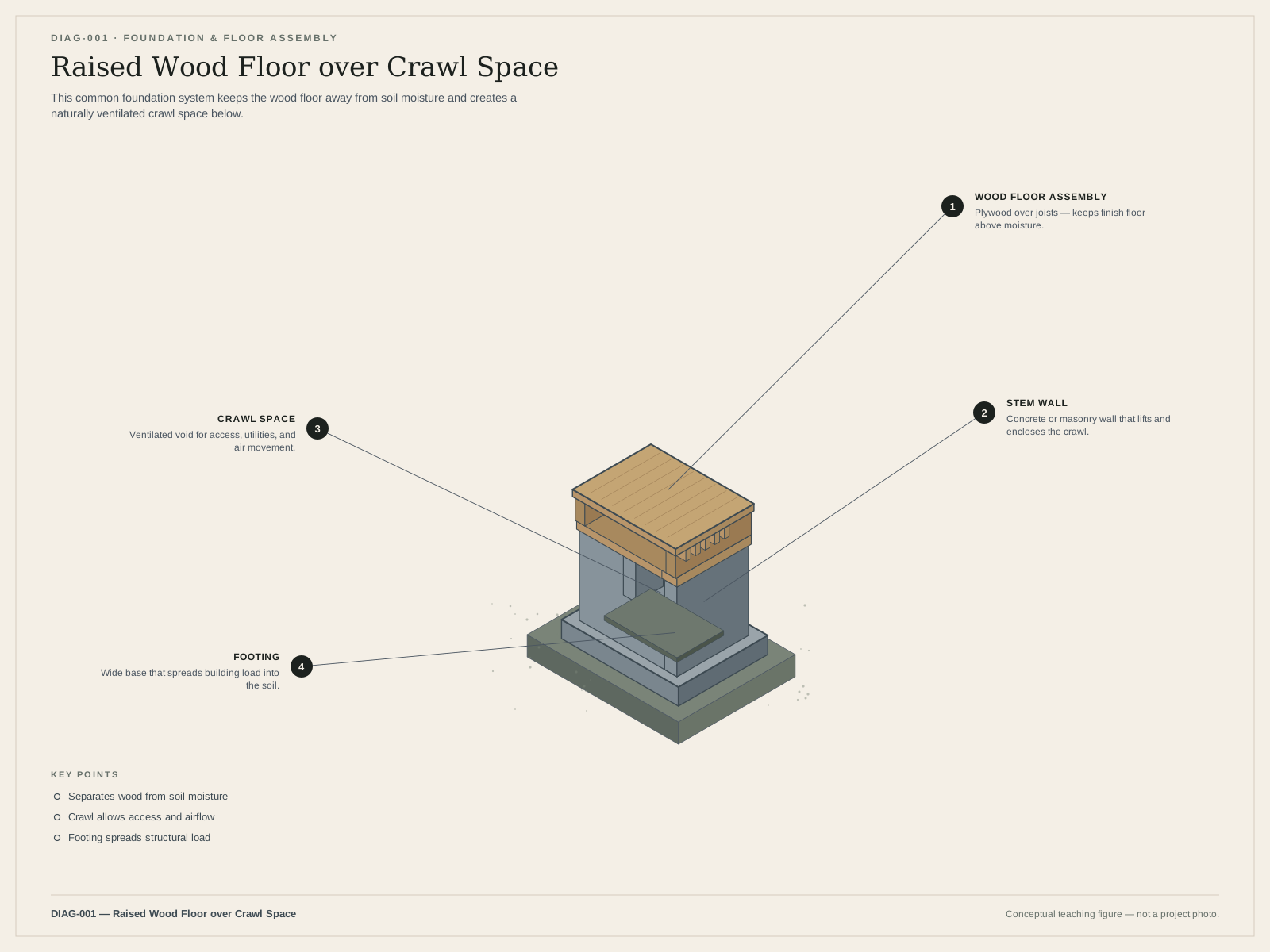
La Jolla’s housing stock in ZCTA 92037 is mid-century-heavy (ACS 2024 5-year estimates: on the order of 19,688 units, with the largest year-built bin in 1970–1979). Public local practice documents describe continuous strip/spread footings, stem walls with framed floors and crawl spaces, slab-on-grade, stair-stepped slope footings, and pier/caisson + grade-beam systems on canyon and hillside lots. That diversity is illustrative—not a cost survey.
Access changes means and methods:
- Crawl-space / raised wood floor — often allows underfloor access for bracing, sistering, pier work, or drainage; height, utilities, and neighbor/easement limits still constrain work
- Slab-on-grade — re-support or repair may require cutting, tunneling, exterior excavation, or interior disruption—different logistics than crawl work
- Hillside / canyon / bluff lots — equipment staging, limited street access, temporary shoring, stair-stepped footings, and possible ESL or Coastal constraints raise complexity independent of any dollar claim
If you do not yet know whether you have a crawl space, slab, or deep-foundation system, request evaluation before comparing construction bids.
Cost factor 3 — Geotech and engineering (fees uncertain / project-specific)
City Information Bulletin IB-141 calls for geotechnical investigation when foundations bear on fill or expansive soil (as defined in the California Residential Code) for covered dwelling types. San Diego Municipal Code §145.1803 / Table 145.1803 and City Guidelines for Geotechnical Reports tie hazard categories and deep foundations (piers/pilings) to geotech recommendations—vertical and lateral capacity, embedment, downdrag, seismic slope demands, and related design inputs. California Building Code §1803.5.5 (deep foundations) and City Building Permit practice commonly expect stamped structural plans/calculations and, as required, a geotechnical report.
Civil engineers may perform structural or geotechnical work if competent; “Structural Engineer” and “Geotechnical Engineer” are title authorities under BPELSG. Do not invent a “typical PE fee in La Jolla.” Ask who is engineer of record, what documents the City will require, and how professional fees are billed before you treat a contractor marketing number as complete.
Cost factor 4 — City of San Diego construction-permit fees (municipal fees, not repair prices)
La Jolla ZCTA 92037 sits inside the City of San Diego. Building Permits, plan check, and most development fees are administered by the Development Services Department (DSD). County of San Diego Planning & Development Services fee handouts do not control City parcels—label jurisdiction correctly.
The following dollars come from City IB-501 Fee Schedule for Construction Permits–Structures (August 2026 web bulletin; fees are subject to periodic DSD updates—verify the current bulletin before relying on exact cents). A public notice documents a 7.25% DSD Enterprise Fund fee increase effective May 4, 2026.
Table 501C — Foundation Repair (City fees only)
| Fee type | Amount (per building) | What it is |
|---|---|---|
| Plan Check | $2,120.01 | DSD plan-check fee for the Foundation Repair permit category |
| Inspection | $353.13 | DSD inspection fee for that category |
These are not the cost of performing foundation repair. They are a visible, citable slice of municipal process cost.
Related IB-501 examples (still City fees)
- Table 501B — Piles, Pile Cap and Grade Beam: Plan Check $1,059.40 each (line item when that permit type applies—not a pier installation price)
- General Plan Maintenance Fee: $737.00 once per project needing plan review
- Mapping Fee: $12.16 when plans/drawings are used for review
- Heritage Preservation (Designated or Potential Historical Resource Review): about $177.68/hr (IB-501) / $177.66/hr (IB-503 Planning line)—older 92037 stock often hits the 45-year review path; hours are project-variable (total uncertain)
- Lead Hazard Prevention Fee: $58.00 on Building/Demolition Permits for structures built before 1978 (issuance fee—not a repair quote)
- State strong-motion / Building Standards fees assessed on valuation (see IB-501 / IB-101)—do not invent project valuation
- Hourly DSD plan review / inspection rates for services outside flat tables (e.g., about $176.84/hr in the Aug 2026 bulletin)
Under San Diego Municipal Code §129.0202, a Building Permit is generally required for structural repair. The narrow ≤$1,000 similar-materials maintenance exemption (§129.0203) does not cover typical structural foundation work. “No permit needed” is not a safe blanket claim.
Cost factor 5 — Coastal Overlay, ESL, and discretionary deposits
When Coastal Development Permit (CDP), Site Development Permit (SDP), or related discretionary paths apply, IB-503 Fee/Deposit Schedules for Development & Policy Approvals/Permits (May 2026) adds another cost layer—still not construction pricing:
- CDP deposit account: initial deposit $8,000; subsequent minimum balance $4,000 (Table 503B). Applicants pay all staff processing costs beyond the deposit. City FAQ language notes simple projects can land in a few-thousand-dollar range while complex or controversial projects can expend far more—uncertain / project-specific
- SDP (often relevant with ESL steep hillsides, including ≥25% natural gradient criteria under SDMC §143.0142): same $8,000 / $4,000 deposit pattern; multiple approvals add deposits
- Flat-fee path examples when eligible (Table 503A): Coastal Development Permit–Single Dwelling Unit/Companion Units (Process 2 only) $30,914.15; Emergency CDP and/or SDP $17,488.14; Neighborhood Development Permit $14,838.42. Flat fees are intended to cover limited review cycles; excess reviews bill hourly
- Administrative add-ons at discretionary submittal: Mapping $12.16; Discretionary Project Close-Out $1,264.48
IB-402 notes Coastal Overlay exterior-wall demolition rules (≥50% exterior walls) and other SDMC §126.0704 triggers can require a CDP even when foundation work under remaining walls is contemplated. Foundation replacement under walls that remain can be compatible with certain demolition calculations if walls stay in place (surveyor verification)—still not a free pass on all Coastal rules.
City Seismic Safety Study geologic hazard categories, Alquist-Priolo strands of the Rose Canyon Fault Zone (La Jolla quadrangle), and ESL steep-hillside mapping are parcel checks—not community-wide claims that every La Jolla house needs the same discretionary stack.
When excavation, site grading, or public right-of-way work is part of the repair, IB-502 applies separate plan-check, inspection, and deposit structures. Cite the current IB-502 tables for your sheet count and cubic yardage; this page will not invent grading totals.
Hillside caution and insurance literacy
The October 3, 2007 Soledad Mountain Road slope failure—summarized in ASCE / SDSU materials—involved reactivation of an ancient bedding-plane landslide after historic grading removed toe support. Use that history only to understand why slope stabilization is not the same as house underpinning, and why complex hillside work can involve extensive investigation, engineering, and permitting. It is not a quote for any current address, and this site does not claim involvement in that project.
FEMA FloodSmart materials discuss that earth-movement / differential settlement damage is generally not treated as flood damage for National Flood Insurance Program claim purposes. Do not assume flood insurance pays for settlement underpinning. Homeowners insurance earth-movement exclusions are policy-specific—refer to your insurer.
CSLB consumer cost-protection (not repair prices)
Before you sign:
- Verify license status, classification, bond, and workers’ compensation at cslb.ca.gov. Classes are scope-dependent (commonly A and/or B; specialties such as C-8 Concrete, C-61/D-30 pile/jacking, or C-21 where underpinning/cribbing language applies—read statutory limits). B-2 Residential Remodeling is barred from structural footing/foundation changes
- Home improvement down payment generally may not exceed $1,000 or 10% of the contract price, whichever is less, unless a qualifying Blanket Performance and Payment Bond is on file with CSLB (Business & Professions Code §7159.5; CSLB consumer guides). Progress payments must not exceed value of work performed
- CSLB advises getting at least three written bids on identical plans, specs, and scope; beware abnormally low bids; require written contracts with payment schedules
- A contractor license bond is not a warranty of workmanship quality and is often insufficient for large claims—do not treat bonds as consumer warranties
Ask what is included versus excluded: drainage, finish restoration, landscaping, utility relocation, monitoring, future landsliding, and adjacent grading. Ask how “success” is defined—stabilize in place versus lift/re-level, and what residual movement tolerances appear in the geotech/structural documents. Ask who pulls the permit, who is engineer of record, and who pays City fees versus construction.
How to compare bids without a fake price menu
- Match mechanism first (inspection / engineering), then method
- Confirm whether the bid assumes stamped plans and a geotechnical report—or is a guess without them
- Separate City fee literacy (IB-501 / 502 / 503) from construction line items
- Check Coastal Overlay, ESL, historic 45-year path, and geologic hazard maps for your parcel
- Compare three written scopes that use the same drawings and inclusions
- Ignore warranty theater (“lifetime,” “permanent stop to settlement,” “guaranteed bluff stability”) from parties who have not investigated the lot
National “average cost” tables, competitor price menus, and online quote widgets that spit out a firm number without a site visit belong in the same bin: guessing dressed as marketing.
Related pages
- Foundation Repair — umbrella process and methods overview
- Foundation Inspection — evaluation before construction bids
- Foundation Crack Repair — localized crack treatments vs structural work
- Foundation Settlement Repair — differential movement context
- Foundation Underpinning — deepening support concepts
FAQs
What is the average foundation repair cost in La Jolla?
There is no verified community-wide average this site will publish. Cost follows mechanism, access, foundation system, geotech/engineering needs, City fees, and discretionary overlays. Anyone stating a firm ZIP-code price band before seeing your property is guessing.
Are City IB-501 Foundation Repair fees what I’ll pay the contractor?
No. Table 501C plan-check ($2,120.01) and inspection ($353.13) fees per building are DSD municipal fees. Construction, geotech, engineering, drainage, and restoration are separate and site-bid only.
Will I need a Coastal Development Permit or Site Development Permit?
Possibly—if Coastal Overlay, ESL steep-hillside, or other SDMC triggers apply. IB-503 deposit patterns ($8,000 initial / $4,000 subsequent minimum for CDP or SDP) are processing deposits, not construction prices. Confirm with Development Services for your parcel.
Do I need a geotechnical report before getting construction bids?
Often yes when fill, expansive soil, mapped geologic hazard categories, deep foundations, or Building Official requirements apply (IB-141, SDMC Table 145.1803, City geotech guidelines). Bids without required studies are not comparable.
How much can a contractor ask as a down payment?
For covered home improvement contracts, California rules generally cap down payments at $1,000 or 10% of the contract price, whichever is less, unless a qualifying blanket bond is on file with CSLB. Verify current CSLB consumer guidance.
Will flood insurance cover settlement underpinning?
Generally earth-movement / differential settlement is treated differently from flood damage under NFIP materials. Confirm with your insurer; do not assume coverage.
Should I hire the lowest bid?
Compare identical scopes, license classifications, engineering involvement, drainage inclusions, monitoring, and permit responsibility—not only the bottom line. Abnormally low bids are a CSLB-flagged warning sign.
Request a Foundation Evaluation
Ready for a grounded next step? Share what you are seeing at your La Jolla property—symptoms, foundation type if known, and any prior reports—and we will help connect you with licensed specialists whose scopes match the issue. Expect evaluation and diagnosis before anyone pretends to know your total cost.