
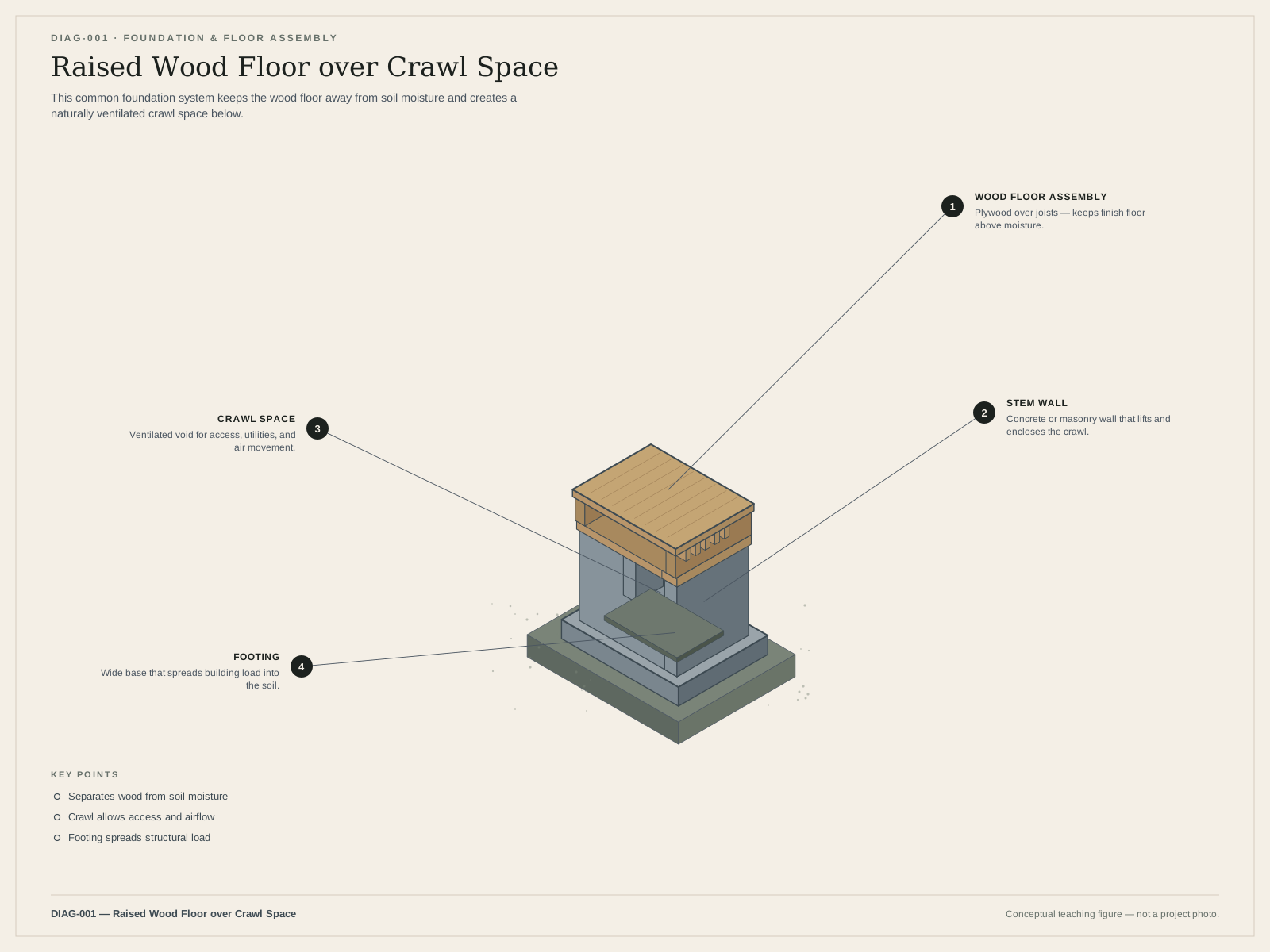
Foundation repair in La Jolla is rarely a single product you can order from a photo. Homes sit on coastal bluffs, canyon edges, Mount Soledad hillsides, and more level mesa-like pockets. Housing stock in ZIP 92037 is heavily mid-century and older, and foundation systems vary by era and topography. This page explains what homeowners should understand before authorizing work—and how to discuss your foundation problem with licensed specialists who serve La Jolla.
La Jolla Structural connects property owners with appropriate professionals. We do not impersonate a contractor or engineering firm, invent credentials, or quote fixed prices.
Discuss Your Foundation Problem
What foundation repair actually addresses
“Foundation repair” covers work that restores support, controls unacceptable movement, or corrects damage to footings, stem walls, slabs, piers, grade beams, and related elements. Successful projects usually start with cause identification, not with a preferred gadget.
Mechanisms that appear in engineering practice include:
- Differential settlement — uneven downward movement that cracks finishes, racks openings, and throws floors out of level
- More uniform settlement — the structure lowers more evenly; finishes may look better while utilities and exterior grades still suffer
- Expansive soil volume change — wetting and drying cycles; City guidance calls for geotechnical reporting when foundations bear on expansive soil as defined in the residential code
- Fill or undocumented fill — another common City geotech trigger for foundation design
- Slope movement, lateral displacement, or bluff-related loss of support — especially relevant on hillside and coastal parcels
- Seismic effects — shaking damage or residual distress is distinct from surface-fault rupture rules under the Alquist-Priolo framework
- Moisture contributors — poor drainage, irrigation, plumbing leaks, or erosion that change soil support over time
Only investigation can tell which of these—if any—apply to your lot. Repair that ignores the driver often fails early or simply decorates an ongoing problem.
Who typically needs foundation repair services
Homeowners and buyers usually arrive here after one of these triggers:
- Visible cracking or out-of-level floors that are getting worse
- A general home inspection that flagged foundation or drainage concerns
- A remodel that exposed stem-wall, sill, or footing deterioration
- Hillside or retaining-wall movement near the structure
- Lender, insurer, or escrow questions that require professional clarification
- Interest in strengthening or correcting issues before listing a property
If you are still deciding whether the issue is cosmetic or structural, start with a clear foundation inspection path rather than jumping straight to construction bids.
Warning signs that warrant evaluation
Seek a qualified look when you notice:
- New, widening, or offset cracks in concrete or masonry foundations
- Interior drywall cracks that track with floor slope or sticking doors
- Gaps at cabinets, counters, or exterior stairs
- Crawl-space posts, beams, or stem walls that look displaced or deteriorated
- Retaining walls or grades pulling away from the house
- Sudden changes after storms, irrigation adjustments, or nearby construction
- Doors that latch on some days and bind on others in ways that track seasons or watering
A crack alone is not proof of structural failure. Dismissing a pattern of movement as “just old house character” is equally unwise. Patterns, progression, and related symptoms matter more than any single hairline mark.
Why La Jolla properties need local context
Community setting
La Jolla’s planning documents describe a nearly built-out coastal community of the City of San Diego—on the order of 5,700 acres—where infill dominates. Steep hillside criteria (including Environmentally Sensitive Lands concepts tied to steep natural slopes) and coastal bluff themes appear throughout local planning. That setting raises the odds that drainage, slope stability, access, and discretionary review layers matter—not that every home needs underpinning.
Seismic and geologic mapping
Strands of the Rose Canyon Fault Zone are mapped through La Jolla; official Earthquake Fault Zone maps for the La Jolla and Point Loma areas took effect in September 2021. City Seismic Safety Study categories can also flag landslide-prone formations, coastal bluff issues, liquefaction in limited settings, and other hazards. Check your parcel with official maps and tools; do not generalize from neighborhood rumor or assert that “all of La Jolla” sits inside an Alquist-Priolo zone.
Regional geology vs. your parcel
Regional geologic mapping describes the Mount Soledad Formation—conglomerate and sandstone associated with the Mount Soledad anticline—as part of La Jolla’s geologic story. Individual geotechnical reports may also discuss terrace deposits, residual soils, fill, or bluff conditions. Those findings are parcel-specific. Advertising a single soil story for every 92037 lot would be inaccurate.
Foundation diversity
Public geotechnical narratives for La Jolla addresses commonly describe continuous strip or spread footings, stem walls with framed floors, stair-stepped footings on slopes, and sometimes pier/caisson with grade-beam systems. Those examples illustrate diversity. They are not a market survey claiming one dominant foundation type, and they are not a diagnosis of your home.
Housing age
ACS estimates for ZCTA 92037 show roughly 19,700 housing units, with a large pre-1980 share and a strong 1970–1979 construction bin. Older homes may combine dated detailing with later additions, remodeled drainage, or hillside grading whose fill quality is unknown until tested. Exact crawl-space versus slab percentages are not published in the year-built table—so this site will not invent them.
Evaluation and diagnosis before repair
A credible path usually looks like this:
- Document symptoms — photos, approximate crack widths, rooms that feel out of level, moisture clues, and when changes started.
- Choose the right professional lane — home inspection for broad due diligence; structural engineering for load path and distress interpretation; geotechnical investigation when soils, slopes, fill, expansion, or mapped hazards drive design.
- Align with City expectations — structural foundation repair generally needs a City of San Diego Building Permit. Under Municipal Code rules, regulated structures generally cannot be repaired without a permit unless a narrow exemption applies. Plans, calculations, and a geotechnical report may be required depending on hazard category, soil conditions, and Building Official determination.
- Screen other layers — historic review for many structures 45 years or older; Coastal Overlay and ESL considerations on hillside or coastal scopes. City coastal guidance notes that replacing foundations under walls that remain can be compatible with certain remodel rules—but other Coastal Development Permit triggers can still apply.
- Only then select methods — piers, underpinning, slab work, drainage corrections, or crack treatments follow the diagnosis.
Cosmetic foundation crack repair can be appropriate for dormant, non-structural cracks. When movement continues, sealing alone may hide the problem. Active foundation settlement repair needs a different conversation about support, soils, and monitoring.
Repair methods homeowners hear about (descriptive, not prescriptions)
Specialists may discuss terms such as:
- Underpinning and deepening foundations to more competent material
- Helical or resistance piers; drilled piers, piles, or caissons with grade beams
- Structural repairs to stem walls, footings, and connections
- Slab repair, partial replacement, or re-leveling approaches for slab foundations
- Work specific to raised foundations and crawl-space framing
- Pressure or compaction grouting in selected soil conditions
- Epoxy or polyurethane injection for certain cracks (often bonding or water control—not always a structural “fix”)
- Mudjacking / slabjacking where appropriate
- Sistering, shoring, and temporary support during construction
- Drainage, grading, and moisture corrections that support long-term performance
Method selection is engineering-driven. The fact that a contractor classification exists for pile driving, caisson work, foundation jacking, or related concrete/mortar injection does not mean that method fits your soil profile, slope condition, or City permit requirements.
Learn more about foundation underpinning when deepening support is on the table, and review foundation repair cost factors when you are budgeting—without expecting an honest site to publish invented “average La Jolla prices.”
Distinguishing symptoms, evaluation, and repair
Homeowners get better outcomes when they keep three layers separate:
- Symptoms are what you see (cracks, slopes, sticking doors).
- Evaluation explains likely mechanisms and whether movement is active.
- Repair is the engineered and permitted response—if one is needed.
Skipping evaluation to “save time” often produces competing contractor proposals that cannot be compared because they assume different causes. On hillside and older coastal-adjacent homes, that shortcut is especially risky.
Process: from first call to completed, permitted work
1. Intake and triage
Describe location (La Jolla / 92037), foundation type if known, symptoms, and any prior reports or disclosure documents.
2. Site evaluation
Access crawl spaces or slabs as feasible; note drainage, irrigation, and slopes; review mapped hazards at a screening level.
3. Technical studies when warranted
Geotech borings and lab work; structural calculations; survey baselines or monitoring if movement appears active.
4. Design and permits
Stamped documents when required; Building Permit through City of San Diego Development Services; additional coastal or historic processes if triggered. Timelines vary—this site will not invent them.
5. Construction by a properly classified CSLB licensee
Verify license class against the actual scope. Residential remodeling classifications that cannot contract structural footing or foundation changes should not be asked to perform that work.
6. Inspections and closeout
City inspections on permitted work are separate from private engineering observations. Keep reports, as-builts, and any warranty documents issued by the licensed contractor—not by this website.
Discuss Your Foundation Problem
Engineering, licensing, and consumer protection
- Design / evaluation: California-licensed civil, structural, and/or geotechnical professionals through BPELSG.
- Construction: CSLB licensees with classifications matching the method (commonly general engineering and/or building licenses plus specialties such as concrete or limited foundation specialties, depending on scope).
- Your homework: Use official license lookup tools, ask who pulls the permit, and get clarity on what success looks like (monitoring, elevation targets, drainage responsibilities). Tolerable movement criteria that appear in individual geotech reports are project-specific, not citywide advertising numbers.
Cost factors (no fixed ranges)
Price depends on access, foundation type, depth to competent material, number of support points, drainage scope, engineering and geotech fees, permit and possible coastal/historic review, temporary shoring, utilities, finishes, and whether movement is ongoing. Anyone offering a firm number before seeing the site and defining scope is guessing. See foundation repair cost for a deeper factor list—still without fake price menus.
Related services and problem pages
- Foundation Inspection
- Foundation Crack Repair
- Foundation Settlement Repair
- Raised Foundation Repair
- Slab Foundation Repair
- Foundation Underpinning
- Foundation Repair Cost
Hillside, retaining-wall, drainage, and seismic pages elsewhere on the site address specialized contexts that often intersect with foundation repair in La Jolla.
FAQs
Can foundation repair proceed without a permit in San Diego?
Sometimes very limited maintenance replacements fall under a narrow Municipal Code exemption tied to similar materials and a low valuation threshold. Structural foundation repair usually does not qualify. Confirm with the City for your scope rather than relying on a sales script.
Do I need a geotechnical report?
Often yes when fill, expansive soil, mapped geologic hazard categories, non-conventional foundations, or Building Official requirements apply. City Information Bulletin 141 and the Seismic Safety Study framework are the starting references—not a neighbor’s anecdote.
Is injection the same as foundation repair?
Not always. Injection can bond certain cracks or help control water. If the foundation is still moving, you may need support improvements first or instead.
What about Coastal Overlay homes?
Foundation work under walls that remain can align with specific City coastal guidance in some remodel scenarios, but other Coastal Development Permit triggers may still apply. Ask Development Services before assuming exemption.
Should I hire the cheapest bid?
Compare scopes, license classifications, engineering involvement, drainage corrections, and monitoring—not only the bottom line. Mismatched scopes are not real savings.
Will flood insurance cover settlement repairs?
Frequently earth-movement and differential settlement claims are treated differently from direct flood damage. Verify with your carrier; do not assume coverage.
Discuss Your Foundation Problem
Ready for a grounded next step? Share what you are seeing at your La Jolla property and we will help connect you with licensed specialists whose scopes match the issue.
